
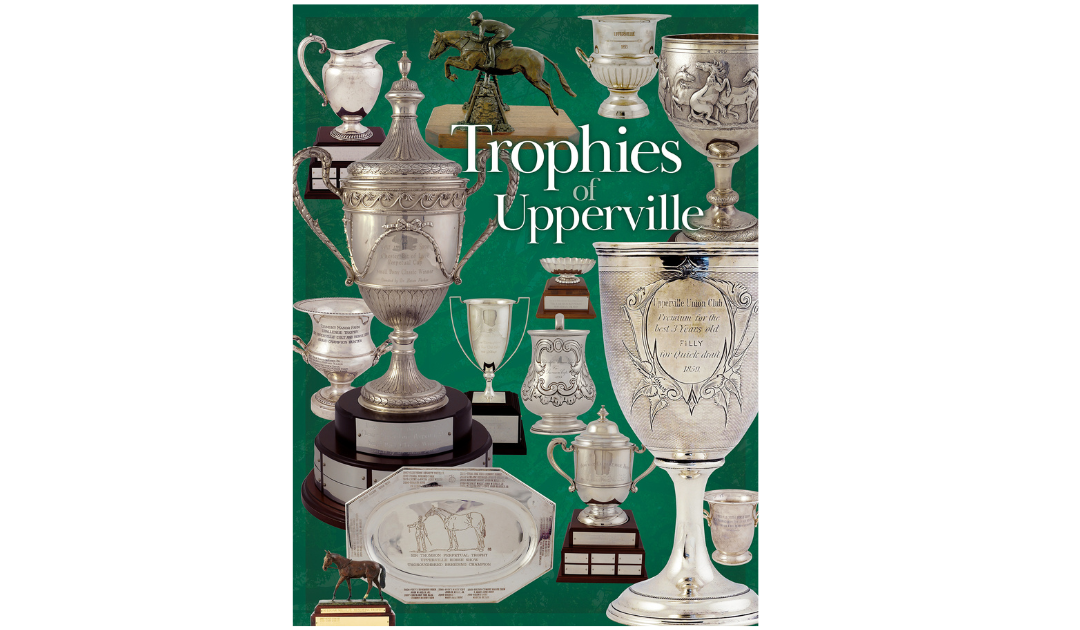
You probably know that our Jump In! Capital Campaign is enabling capital improvements and an endowment, but do you know that it is also helping to preserve the Show’s history? Some of the money raised, a bit of staff time, and a lot of volunteer help are being spent on projects like documenting the Show’s trophies, which tell the stories of people and horses that have competed at Upperville throughout its history. With this issue of the newsletter we start a series to highlight some of our trophies and the people and horses behind them.
When we selected the first two trophies to feature in the inaugural article of this series, we had no idea that the horses they honor shared a common theme as unlikely national champions. But what we never could have possibly guessed was another, deeper link between them.
Beau Mac– the 1969 AHSA High Score Hunter
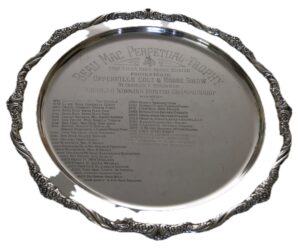
For over fifty years – since 1971 – the winner of Upperville’s Regular Working (High Performance) Hunter class has been inscribed on a beautiful silver tray with a repoussé border — the Beau Mac Perpetual Trophy, donated by Charles McGinnes in honor of Beau Mac, a hunter that played an extraordinary role in Charles’ life.
Charles and his wife, Cynthia, operate Thornmar Farm on Maryland’s Eastern Shore, where since 1972 they have bred and foaled as many as 100 mares per year. At Thornmar, they stood the Breeders’ Cup–winning stallion Horatius, sire of Eclipse Award winner Safely Kept. The McGinnes were named Maryland Horse Breeders Association Breeders of the Year in 2004. Long before that recognition, however, one of Charles’ most successful matings was not a Thoroughbred destined for the racetrack. It was Beau Mac, a part-bred son of an unlikely pairing who became his first champion.
Charles recalls that, as a young man, he lived in Glen Arm, Maryland, and rode a half-Saddlebred mare that he and his father had purchased from a local stable. Nearby was also Worthington Farms, owned by family friend and U.S. Senator Daniel Brewster, which had a Thoroughbred teaser stallion named Penance. Penance had been bred at Llangollen Farm in Upperville, owned at the time by Liz Whitney; although he had not distinguished himself racing, he had royal blood lines.
After a tour of Worthington, Charles wanted to breed his half-Saddlebred mare to Penance. It took a lot of persuading and a call to Liz Whitney to confirm the stallion’s bloodlines, but Charles’ father finally agreed, albeit to just one attempt. Fortunately, one was all it took. The following Spring, while Charles was away at college, his father walked into the barn one morning to discover that the mare had foaled a colt entirely on her own. They named it Beau Mac, giving a nod to their family name.
Beau Mac was raised by the McGinnes family and later started under saddle by Charles and a group of friends with whom he worked during summers at Sagamore Farm – “we were all amateurs”, he recalls. From there Beau Mac went on to a professional training stable. Fran Clemmons was the first to jump the horse Charles recalls simply as “a natural.”
Beau Mac quickly accumulated blues and tricolors, first at local competitions and then at larger venues throughout Maryland and Virginia. In 1968, when Charles became editor of Florida Horse and relocated to Ocala, he sent Beau Mac to Steve Stephens and Gene Mische to continue his career on the Florida circuit and at the national level. The brilliant gelding went on to win at Devon, Upperville, Warrenton, Chagrin Falls, Detroit, and Madison Square Garden, with Stephens doing most of the riding and Joan Boyce adding victories in the Ladies’ classes.
Beau Mac concluded the 1969 season as the American Horse Shows Association (AHSA) High Score Hunter. He was subsequently sold to the president of Coto de Caza in Southern California and was shown primarily by Max Bonham for the remainder of his career before retiring to the owner’s farm in Alabama.
Beau Mac was Charles’ first homebred—a horse whose story Charles fondly describes as one of “rags to riches.” When he decided to donate a trophy in Beau Mac’s honor, Charles chose to give it to Upperville because it was always one of his favorite shows and the site of one of Beau Mac’s most memorable victories.
Baron von Laken
In the summer of 1993, Lisa Kline sent Baron von Laken to Tony Workman’s Winter Hill Farm in Hillsboro, Virginia to be sold. The quiet, handsome dark bay gelding of unusual breeding (Trakehner x Arab/Egyptian Thoroughbred) had been a trusted school horse at the Great Falls Equestrian Center, but now needed an easier job due to a chronic foot soundness issue requiring careful management. Ruth Douglas was already showing her Stonebrook’s Harry with Workman’s help and was casually looking for another horse to practice on at home. Tony called her one day to come try the new sales horse.
We reached Ruth recently at her home in Rhinebeck, New York. She recalls feeling at home on “Baron” as soon as she sat in the saddle. She mounted up and walked in the ring, rode him all around, and jumped every jump that was set up. “I thought he was just adorable,” she said. As talented and safe as Stonebrook’s Harry was, he had a sticky lead change that sometimes made winning a challenge for his amateur rider, but Baron exhibited perfect, automatic changes during their trial that day, sealing the deal for Ruth. She brought him back to the walk at the end of her school and announced, “I have to have him!”
The purchase agreement was soon made and Baron Von Laken moved to the Douglas’ Stonebrook Farm in nearby Waterford where Ruth got to know him better until Workman decided they were ready to show. A first and second place over fences in the Adult Amateur Hunter division at the Maryland Horse & Pony Show that September became the start of a seven-year winning streak for Ruth and her “practice horse,” including tricolors at Upperville, Loudoun Benefit, Middleburg Classic, and The Barracks, as well as top honors in the Miller’s Adult Hunter Classic at the Washington International Horse Show. Tony Workman remembers Ruth telling him as she schooled in the ring at Washington in the early morning of the competition that it was a “dream come true” just to be there. But, by seven o’clock that night, Workman said, “they won the whole thing, with Linda Andrisani and Rob Bielefeldjudging!”
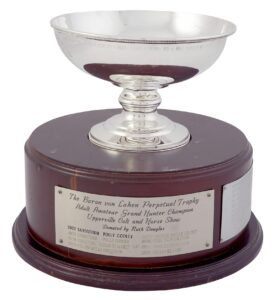
Baron retired after the 2000 season and lived out his remaining years at Stonebrook, where he is buried. Douglas donated the stately silver bowl trophy to Upperville two years later, to celebrate Baron’s own win there in 1998 and as a gift to the show where Ruth and husband, Hal, shared so many fond memories with their horses and friends. The trophy is awarded to the Grand Adult Hunter Champion.
Stonebrook’s Harry finished his career the way Baron’s started, teaching tiny tots at a lesson stable. Stonebrook’s Harry, who was Thoroughbred, is the deeper link- the plot twist- in our story. Harry was sired by a stallion whose progeny were becoming as well-known as sport horses in the 1990’s as they were on the racetrack—a Maryland-based stallion called Horatius, owned in partnership by Mr. & Mrs. Charles McGinnes. The very same Charles McGinnes who bred Beau Mac!
If you have memories of Beau Mac, Baron Von Laken, or other trophy information you’d like to share, we welcome your input emailed to: [email protected].